CEARGO
One confirmed record of what happened at a stop, that shipper and carrier both accept.
When a truck waits at a dock, or a delivery is disputed, each side has its own account and neither trusts the other's. ceargo is software that matches each stop to its order and keeps one record both sides can see, so a detention or accessorial charge can be paid, or refused, on evidence.
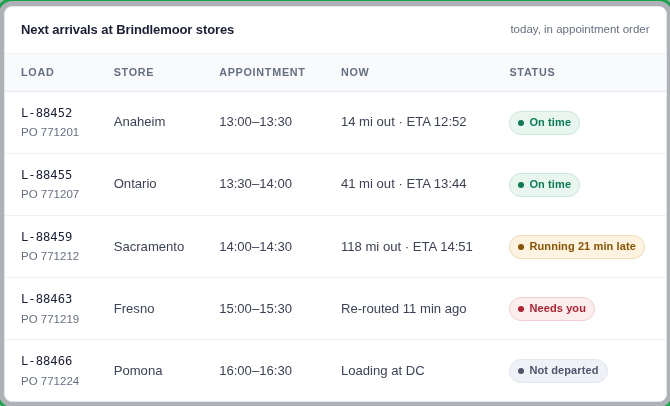
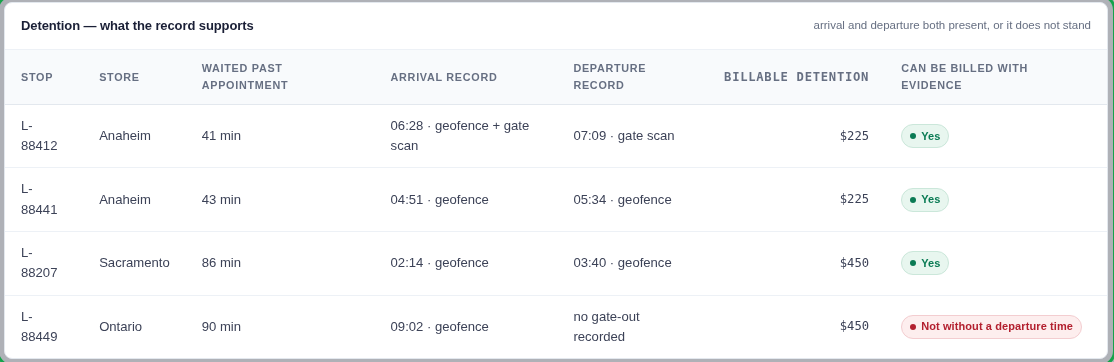
Where this stands. ceargo is in development. It has no customers, no prices and no availability date, and nothing on this page is a testimonial. The screens below show invented data.
Who it is for
- Shippers and receivers who pay carrier charges and want each one tied to a stop and an order before it is paid.
- Carriers, including small ones with no transportation system, who need to show that they arrived, waited and left.
Both sides write to the same record. A confirmation only one side can write is that side's claim; ceargo is built so that either side can add to it, see it, and dispute it.
How it works
- Match the stop to its order. A pickup or delivery is tied to the purchase order or load it belongs to.
- Record arrival and departure. Each time is kept with how it was captured, for example a location boundary or a gate scan.
- Both sides see it. The shipper and the carrier each get a view of the same record, and either can add a document or raise a dispute.
- Charges point at the evidence. A detention or accessorial charge shows the arrival and departure records behind it, or shows what is missing.
A carrier with no IT staff is meant to be able to take part from a phone. Systems that already exchange shipment data can connect to the same record.
Example screens, invented data
How it relates to the Open Shipment Record
ceargo does not define the data format. It lists itself as a connected system of the Open Shipment Record, an open profile of existing standards (GS1, UN/CEFACT, X12 EDI, NMFTA, DCSA and UBL) that describes a minimum shipment record. Software from any vendor can do the same, and ceargo is one such system.
The Open Shipment Record is kept apart from ceargo and is meant to have its own site. No register, certifier or conformance mark exists for it, and no standards body has endorsed or been asked to endorse it. The name is provisional. Anyone can check a shipment record against the draft profile in the browser; the record never leaves the page.